Built for Large-Scale Agricultural Use
Commercial Agricultural Fencing in the Chicago, Illinois Area
Commercial agricultural fencing must withstand greater demands than fencing installed on smaller residential or rural properties. Long perimeters, concentrated livestock pressure, frequent gate use, changing weather, and regular equipment traffic require a fencing system designed for dependable performance.
Long Fence Runs
•
Heavy-Use Performance
•
Commercial Equipment Access
•
Chicago Area Service
Fencing for Commercial Operations
A Fence Built to Support Daily Agricultural Work
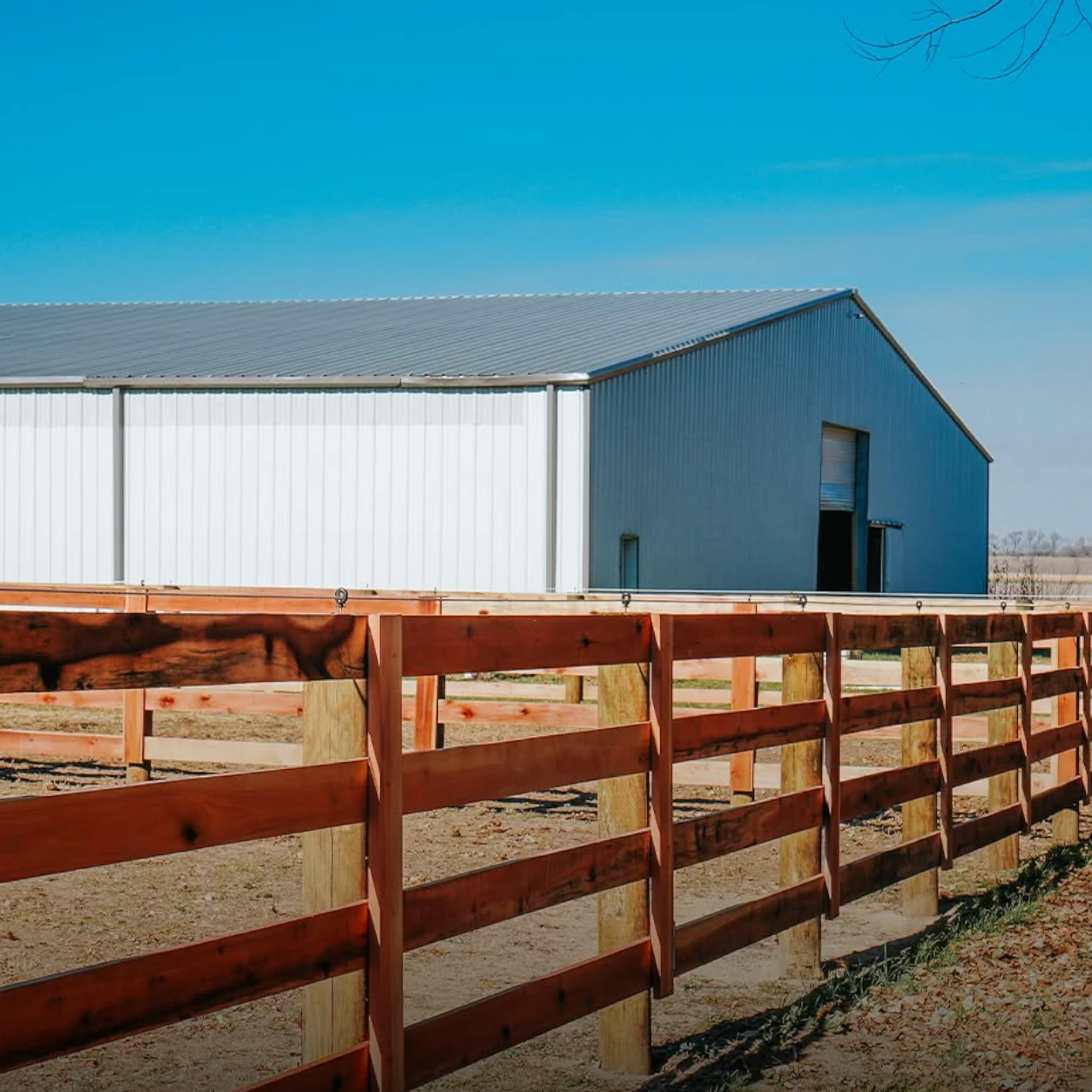
Commercial agricultural properties place greater demands on fencing than smaller residential or rural projects. Long perimeters, concentrated livestock pressure, frequent gate use, changing weather, and regular equipment traffic all require a fencing system designed for dependable performance.
Farmland Fencing plans and installs commercial agricultural fencing for farms, ranches, livestock operations, production properties, and other working agricultural sites. Materials and layouts are selected according to stocking density, land use, terrain, pressure points, access requirements, and long-term maintenance expectations.
The objective is a strong, efficient fencing system that protects the operation without creating unnecessary obstacles for livestock, employees, vehicles, or machinery.
Commercial Fencing Solutions
Fence Systems for Demanding Agricultural Operations
Commercial projects may combine several fence types. Each section is selected for its purpose, livestock pressure, run length, maintenance needs, and the level of control required across the operation.
High-Tensile Fencing
Create strong, efficient fencing for long runs and large agricultural areas using properly tensioned wire, secure bracing, and durable posts.
Woven-Wire Fencing
Provide dependable containment for livestock, fields, pastures, and high-use areas with a closely spaced wire-mesh barrier.
Barbed-Wire Fencing
Build durable, economical fence lines for cattle, agricultural boundaries, remote sections, and long commercial perimeters.
Electric Fencing
Strengthen livestock control, protect high-pressure areas, and create practical internal divisions using properly planned electrified fence lines.
Field Fencing
Protect and divide crop fields, grazing areas, and working sections while maintaining practical access for vehicles and farm equipment.
Perimeter Fencing
Secure the outside limits of the operation with durable fence lines planned around property boundaries, terrain, livestock pressure, and access points.
Engineered for Reliable Performance
Commercial Agricultural Fencing Depends on Proper Design
On commercial projects, small layout or installation problems can become expensive when repeated across hundreds or thousands of feet. Proper planning helps reduce weak corners, uneven wire tension, inconvenient access points, unnecessary maintenance, and disruptions to daily operations.
✓ Total fence length, field layout, perimeter routes, and internal divisions
✓ Stocking density, animal type, pressure points, and containment requirements
✓ Terrain, soil, drainage, elevation changes, and winter conditions
✓ Tractors, trailers, deliveries, employees, and service-vehicle access
✓ Farm gates, equipment gates, livestock lanes, and traffic flow
✓ Electric reinforcement, repair access, replacement planning, and expansion
Our Process
From Operational Review to Installation
01. Review the Operation
We discuss the size and use of the property, livestock, fields, existing fence conditions, pressure areas, equipment routes, gate needs, work schedules, and future expansion.
02. Design the Complete System
Materials, fence routes, post depth, spacing, corner assemblies, bracing, wire tension, electric reinforcement, and large gate locations are planned as one coordinated system.
03. Install for Commercial Use
Fence lines and gates are installed for consistent strength, efficient movement, dependable containment, manageable maintenance, and reliable performance under daily agricultural use.
Commercial Agricultural Fencing FAQs
Questions About Commercial Agricultural Fencing
What fence types work best for commercial agricultural operations?
The right system depends on livestock type, stocking density, run length, terrain, pressure areas, equipment access, and maintenance goals. High-tensile, woven-wire, post-and-wire, barbed-wire, electric, or combined systems may be used across different parts of the operation.
How is a large commercial fencing project planned?
Planning begins with the purpose and route of each fence line. We consider the property layout, terrain, livestock pressure, corners and braces, material quantities, gate access, electric reinforcement, existing fencing, and how installation can support ongoing farm operations.
Can electric fencing reinforce high-pressure areas?
Yes. Electric fencing can be integrated where additional control is needed, including livestock gathering areas, feeding zones, shared boundaries, or other locations exposed to repeated pressure. The complete system must be planned for safe, consistent operation.
Can you repair or replace fencing without rebuilding every fence line?
Often, yes. Existing fencing can be evaluated to determine which sections can be repaired and which require removal or replacement. The goal is to restore dependable containment and access while avoiding unnecessary disruption to the operation.
How much does commercial agricultural fencing cost?
Commercial agricultural fencing costs depend on the total fence length, materials, post spacing, corners, bracing, terrain, soil conditions, gates, equipment access, livestock requirements, and removal of existing fencing. Long, accessible fence runs may be priced differently from projects with numerous divisions, difficult terrain, or multiple heavy-use gates. A property and operational review is needed before an accurate estimate can be prepared.
Can you install gates for tractors and commercial farm equipment?
Yes. Agricultural gates and access points can be planned for tractors, trailers, delivery vehicles, livestock movement, employees, and maintenance equipment. Gate width, location, swing direction, bracing, surrounding terrain, and turning space should be considered as part of the complete fence design. Planning commercial access correctly helps prevent bottlenecks, restricted turns, and costly modifications after installation.
Explore Related Services
Related Services for Commercial Operations
Agricultural Fencing
Compare durable fencing systems for livestock, fields, pastures, crops, and working agricultural properties.
Gate Installation
Add properly sized and braced access points for tractors, trailers, deliveries, employees, and livestock movement.
Fencing Repair
Restore damaged or ineffective commercial fence lines to improve containment, security, and day-to-day reliability.
Start Planning Your Fence
Let’s Plan the Right Fence for Your Operation
Tell us about the size of your operation, livestock, fence-line length, terrain, existing fencing, equipment access, gate requirements, pressure areas, and project location. We’ll help you determine a practical commercial fencing plan.
Professional commercial agricultural fencing throughout the Chicago, Illinois area.