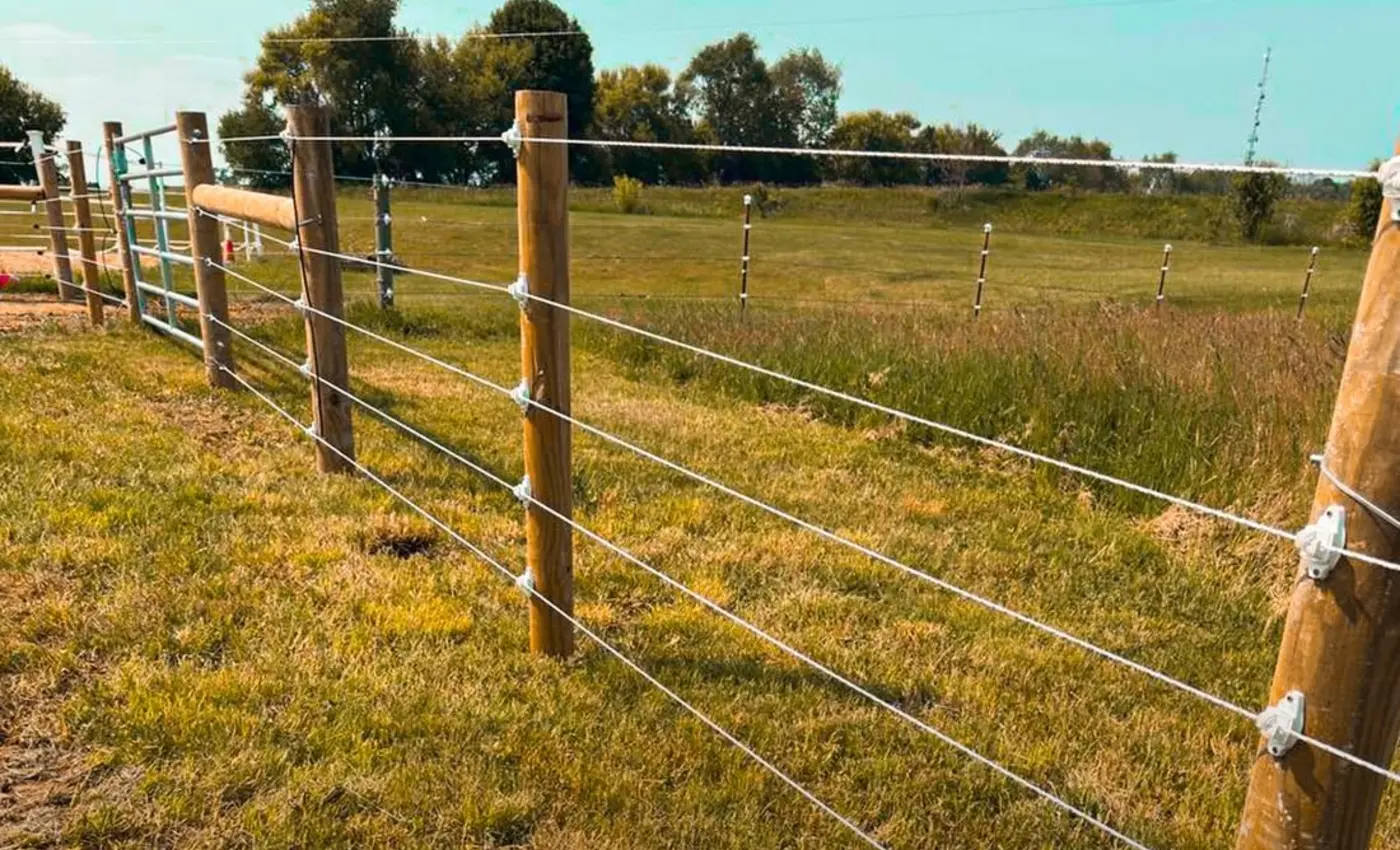
Fence post spacing is one of the decisions that determines whether a farm fence remains straight and dependable or begins to sag, lean, and require frequent repairs. There is no single measurement that works for every fence. The right distance depends on the fence material, the animals being contained, the terrain, soil conditions, post type, wire tension, and the strength of the corner and end assemblies.
For many permanent agricultural fences, line posts may be placed roughly 8 to 16 feet apart. Some properly designed high-tensile or electric systems can use wider spacing, while board fencing and fences exposed to heavier pressure usually require posts closer together. These figures are useful starting points, but the final layout should be designed for the property.
Quick Answer
A common starting range is 8 to 16 feet between line posts, but woven wire and board fencing often require closer support, while properly engineered high-tensile and electric systems may allow wider spacing. Terrain, soil, animal pressure, wire tension, and brace construction must determine the final layout.
Typical Fence Post Spacing by Fence Type
The following fence post distance ranges can help with early planning. Actual spacing should be confirmed after evaluating the fence system, site, and intended use.
| Fence type | Common planning range | What affects the final distance |
|---|---|---|
| Woven wire or field fence | Approximately 8–12 feet | Mesh weight, wire tension, animal pressure, terrain, and bracing |
| Barbed wire | Approximately 10–16 feet | Number of strands, post and stay system, terrain, and livestock pressure |
| High-tensile wire | Approximately 15–30 feet in many designs | Wire specifications, tension, droppers or stays, topography, and end assemblies |
| Permanent electric fence | Approximately 12–30 feet in many designs | Number of wires, post material, terrain, tension, and expected animal pressure |
| Temporary electric fence | Often wider and highly system-dependent | Temporary post, conductor, terrain, wind, and duration of use |
| Board or rail fence | Commonly 6–8 feet | Rail length, lumber dimensions, animal pressure, and post strength |
These ranges intentionally overlap. An installer may reduce the space between fence posts on slopes, near curves, in soft ground, or where animals regularly push against the fence. On a straight, level run with a correctly tensioned system, wider line-post spacing may be appropriate.
Why There Is No Universal Fence Post Distance
A fence is a complete structural system. The line posts support the fence between corners, but the corner, end, and gate assemblies resist much of the pulling force. If an end assembly shifts, adding more line posts will not fully solve the problem.
Likewise, a recommendation for wood fence post spacing does not automatically apply to a high-tensile livestock fence. Each system distributes force differently. Begin with the fence’s purpose, then select materials, spacing, bracing, and installation methods that work together.
Fence Material Changes the Spacing
Woven wire and field fencing
Woven wire creates a strong physical barrier for livestock and can be useful where smaller animals or young stock must be contained. Because the mesh has considerable surface area and weight, it needs consistent support and properly built tension assemblies. Line posts are often placed closer together than they would be in a flexible high-tensile system, and uneven ground may require additional posts to prevent gaps.
Barbed wire fencing
Barbed wire has traditionally been used for cattle and large pasture boundaries. Post distance depends on the number of strands, terrain, wire tension, and whether stays are installed between the main posts. Long, straight runs may permit wider spacing than short sections with frequent turns, but stability and reliable containment remain the priority.
High-tensile fencing
High-tensile fencing uses strong end and corner assemblies to maintain wire tension across the fence line. Line posts may therefore be farther apart in suitable conditions. Nevertheless, rolling ground, curves, gateways, elevation changes, and heavy animal contact can require more support. Wide spacing is not automatically better.
Electric fencing
Electric fencing relies on both a physical boundary and an effective electrical circuit. Spacing varies widely because permanent high-tensile electric fence, temporary polywire, and portable rotational-grazing fence are different systems. The conductor must remain at the intended height without excessive sag, while vegetation, grounding, energizer capacity, and insulators also affect performance.
Board and rail fencing
Board fence spacing is usually governed by the length and strength of the rails. Posts commonly align with the ends of each board, so lumber dimensions influence the layout. In horse areas, visibility and safety matter as much as appearance. Posts, boards, fasteners, gates, and any electric offset should form a complete system that reduces the risk of escape or injury.
Terrain Can Require Closer Post Spacing
A straight fence across level ground is simpler to support than a fence crossing hills, dips, drainage areas, and curves. Elevation changes create places where wire may rise too far above the ground or pull downward with additional force. Installers often add posts at significant high and low points, while curves require careful planning because tensioned wire naturally pulls toward the inside.
- High and low points
- Drainage channels and areas that hold water
- Sharp changes in direction
- Soft, rocky, or disturbed soil
- Locations exposed to drifting snow or strong wind
- Areas where animals gather, lean, or push
- Gate locations and equipment-access requirements
Soil and Post Installation Matter
Even correctly spaced posts can fail if they are undersized or installed in unsuitable ground. Loose, wet, sandy, filled, saturated, or rocky soil creates different installation challenges. Post diameter, material, treatment, embedment, and installation method should match the fence load and site. Northern Illinois weather and seasonal soil movement also need consideration.
Corner, End, and Gate Posts Need Special Attention
Many fence failures begin at a weak termination point. Corner posts, end posts, brace posts, and gate posts carry forces that ordinary line posts are not designed to handle. A strong brace assembly transfers tension into the ground, while gate posts must support the fence tension plus the gate’s weight and movement. Closely spaced line posts cannot compensate for an inadequate corner or gate assembly.
Livestock Pressure Affects the Design
The same field may require a different fence depending on what it contains. Mature cattle, calves, horses, sheep, goats, dogs, and wildlife interact with fencing differently. Young animals may require smaller openings near the ground, horses benefit from highly visible fencing without sharp projections, and cattle areas around feed, water, gates, or handling facilities experience more pressure. The right livestock fencing design may use closer support, stronger materials, an electric offset, or a different fence type.
How to Lay Out Fence Posts Before Installation
- Confirm the property boundary and required setbacks. Do not rely on an old fence line as proof of a legal boundary.
- Mark corners, ends, gates, and direction changes. These structural points come before ordinary line-post spacing.
- Measure each fence run. Use the actual ground route rather than estimating from a map alone.
- Identify terrain changes. Add support at dips, rises, curves, and high-pressure areas.
- Choose a target spacing. Divide the run into reasonably equal sections instead of leaving one unusually short or long space.
- Confirm the brace design and post specifications. Wire, tension, livestock, and soil influence the requirements.
- Check access before installation. Make sure gates accommodate tractors, trailers, mowing equipment, and livestock movement.
Common Fence Post Spacing Mistakes
Choosing the widest spacing to reduce cost
Using fewer posts may reduce the initial material count, but excessive spacing can increase sag, movement, and maintenance. The least expensive installation is not always the lowest-cost fence over its service life.
Ignoring changes in terrain
A pattern that works on level ground may leave gaps or create excessive pressure on rolling land. The fence should follow the property rather than forcing every section into an identical measurement.
Treating every post as a line post
Corners, ends, gates, and changes in direction need stronger construction. These locations should not be built with the same assumptions used for intermediate supports.
Tensioning wire without adequate bracing
More tension is not a cure for weak construction. Excessive or incorrectly applied tension can pull posts out of alignment and damage components.
Forgetting future maintenance access
Vegetation control, snow, fallen branches, equipment traffic, and animal pressure affect a fence after installation. The layout should allow the owner to inspect and maintain the complete fence line.
Should Fence Posts Always Be Evenly Spaced?
Not necessarily. Equal spacing produces an orderly appearance, but performance is more important than visual uniformity on agricultural land. Additional posts may be needed at a dip, curve, slope transition, gate, or high-pressure location. Within each uncomplicated run, posts can be distributed evenly; across the entire property, the distance may change to match the land and function.
Fence Post Spacing FAQ
Frequently Asked Questions
What is the standard distance between fence posts?
There is no universal standard. Many permanent farm fences begin with a planning range of approximately 8 to 16 feet, but board fences often require closer spacing and some engineered high-tensile systems permit wider spacing.
Is 8-foot fence post spacing appropriate?
Eight feet is common for several sturdy fence systems and often works well where frequent support is desirable. Whether it is necessary depends on the material, terrain, animal pressure, and post specifications.
Can fence posts be 20 feet apart?
Some high-tensile and electric systems can use 20-foot spacing under suitable conditions. Do not apply that distance automatically to woven wire, board fencing, difficult terrain, or a system without adequate bracing and tension control.
Should posts be closer together on hills?
Often, yes. Additional posts at elevation changes can help the fence follow the ground, maintain wire height, and resist vertical forces. The exact layout depends on the slope and selected fence system.
Do corner posts count in the spacing?
Corner and end posts define the beginning and end of a fence run, but they serve a different structural role from ordinary line posts. Lay out and brace them first, then divide the remaining run into suitable line-post intervals.
Plan the Fence as a Complete System
Good fence post spacing balances material efficiency, strength, animal safety, terrain, and long-term maintenance. A number from a generic chart provides an initial estimate, but the final agricultural fencing design should account for the complete property. Fence specifications should also follow the selected manufacturer’s requirements and applicable USDA NRCS fencing standards.
Farmland Fencing installs agricultural, livestock, horse, pasture, and post and wire fencing in Rockford, Northern Illinois, and communities throughout the greater Chicago area. If you are planning a new fence or replacing an unreliable fence line, request an estimate so the layout, materials, post spacing, gates, and bracing can be evaluated together.