The best fence for cattle is the one that reliably contains the specific herd, fits the land, and can be maintained for years. A permanent roadside boundary has different demands than an interior paddock divider, and a cow-calf operation may need a different system than a pasture holding mature, fence-trained cattle.
Woven wire, high-tensile wire, barbed wire, and electric fencing can all be practical choices. In many cases, the best cattle fence combines more than one of them. Before choosing, consider whether the fence is a perimeter or cross-fence, the age and temperament of the animals, terrain, soil, gates, vegetation, maintenance, and the consequences of an escape.
Quick Answer
There is no single best fence for every cattle operation. Woven wire offers a strong physical barrier, high-tensile fencing suits many long permanent runs, barbed wire remains practical for mature cattle in suitable pastures, and electric fencing is especially useful for managed grazing and interior divisions. Strong braces, correctly placed gates, and a layout designed for the herd are as important as the fence material.
Cattle Fence Options Compared
This comparison provides a practical starting point. Final specifications should reflect the herd, property, manufacturer requirements, and installation conditions.
| Fence option | Often best suited for | Main advantages | Important considerations |
|---|---|---|---|
| Woven wire | Permanent perimeters, cow-calf operations, and areas needing a strong physical barrier | Continuous barrier, contains different animal sizes, easy to see and inspect | Higher material and installation demand; requires strong bracing and correct tension |
| High-tensile wire | Long pasture boundaries and permanent cross-fencing | Efficient for long runs, flexible system design, can be electrified | Installation quality, tension, grounding, and brace construction are critical |
| Barbed wire | Large pastures containing mature cattle | Familiar, durable, and practical for many rural boundaries | Not ideal for every animal or high-pressure area; must remain tight and visible |
| Electric fence | Rotational grazing, interior paddocks, offsets, and temporary divisions | Flexible, adaptable, and efficient for moving cattle between grazing areas | Requires a reliable energizer, grounding, vegetation control, inspection, and trained cattle |
| Continuous panels | Lots, lanes, corrals, gates, feeding areas, and handling zones | Strong physical control in concentrated pressure areas | Usually too material-intensive for an entire pasture perimeter |
Start With the Fence’s Job
A fence should be selected by function before material. The outside perimeter protects the operation if cattle test the boundary or a gate is left open. Interior cross-fences organize grazing and movement, while lots, lanes, feed areas, and handling facilities experience concentrated animal pressure.
- Perimeter boundaries: prioritize dependable containment, road safety, gates, and long-term durability.
- Permanent cross-fences: balance reliable control with efficient material use across long runs.
- Temporary paddocks: prioritize flexibility, easy movement, and a dependable electrical system.
- Pressure areas: use stronger posts, gates, panels, and bracing where cattle crowd or change direction.
A professional cattle fencing plan may therefore use one system around the property, another between paddocks, and heavier materials near gates and handling areas.
Woven Wire: A Strong Physical Barrier
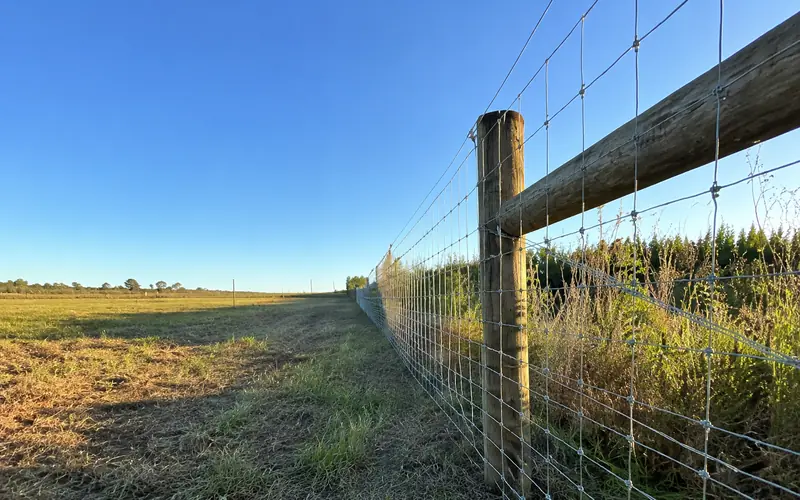
Woven wire fencing forms a continuous mesh barrier rather than relying on several individual strands. That makes it a practical option for cow-calf operations, mixed-size herds, roadside boundaries, and properties that prefer a clearly visible physical fence.
Its effectiveness still depends on the complete installation. Woven wire places substantial load on corner and end assemblies and must follow the terrain without leaving openings underneath. Correct mesh selection, tension, post spacing, braces, and gates determine how well the fence performs. It can require a larger initial investment than simpler wire systems, but the added physical barrier may be worth it where containment consequences are high.
High-Tensile Wire: Efficient for Long Runs
High-tensile fencing can be a cost-efficient permanent option for long pasture runs. The wire is installed as a tensioned system supported by strong corners, ends, and changes of direction. Depending on the design, some or all strands may be electrified.
The main advantage is not simply using fewer materials. A well-designed system can absorb pressure and maintain a clean fence line across long distances. The tradeoff is that shortcuts in bracing, tensioning, insulators, grounding, or post placement can undermine the whole fence. Rolling ground and curves also require additional planning so the wires remain at useful heights.
Barbed Wire: A Traditional Pasture Option
Barbed wire remains common on cattle properties because it is familiar, durable, and practical for large pasture boundaries containing mature cattle. It can be a sensible choice where the herd respects the fence and the terrain allows a straightforward installation.
It is not automatically the best fencing for cattle in every setting. Young stock, crowded areas, damaged wires, weak posts, or poorly maintained tension can increase the chance of escape or injury. Barbed wire should be visible, correctly tensioned, regularly inspected, and kept away from locations where cattle repeatedly crowd or push. Other materials may be better near lots, lanes, and frequent handling points.
Electric Fencing: Flexible Grazing Control
Electric fencing is especially useful for rotational grazing, interior paddocks, temporary lanes, and protecting an existing physical fence from animal pressure. Permanent electrified high-tensile wire and portable polywire are different systems, but both rely on cattle learning to respect the boundary.
An electric fence is only dependable when the complete circuit works. The energizer must suit the fence, grounding must match soil conditions, vegetation must not drain the charge, connections must remain sound, and voltage must be checked routinely. Portable fencing offers valuable flexibility, but it also requires more frequent attention. For a high-consequence perimeter, many owners prefer a permanent physical boundary with electric fencing used as an offset or interior control system.
Continuous Panels: Strength Where Cattle Concentrate
Continuous panel fencing is generally used where cattle gather, turn, feed, enter gates, or move through handling areas. Its strength makes it valuable for corrals, lots, lanes, and other concentrated-pressure locations. Because of its material and installation requirements, it is usually combined with a more economical pasture fence rather than installed around every acre.
How to Choose the Best Cattle Fence
- Identify the cattle being contained. Mature cows, calves, bulls, newly purchased animals, and cattle already trained to electric fence may require different levels of control.
- Separate perimeter and interior needs. Do not assume that a flexible paddock divider should also serve as the only roadside boundary.
- Walk the complete route. Mark slopes, dips, curves, wet ground, wooded edges, road frontage, neighboring property, and locations where animals gather.
- Plan corners, braces, and gates first. These structural points carry greater loads than ordinary line posts and determine how cattle and equipment move.
- Compare installed and long-term cost. Include posts, braces, gates, energizers, vegetation control, repairs, labor, and expected maintenance—not only the price of wire.
- Design for inspection. A fence that cannot be easily checked after storms, snow, falling branches, or equipment contact will become harder to maintain.
Herd, Terrain, and Maintenance Change the Answer
A fence that performs well on a level, open pasture may need modifications on rolling land, around wooded edges, or in low ground. Dips can create openings under the fence, curves redirect wire tension, and wet or disturbed soil can weaken posts. Northern Illinois snow, wind, vegetation, and seasonal soil conditions should also be part of the design.
Maintenance capacity matters just as much. Electric systems need regular testing and vegetation control. Woven and high-tensile wire depend on sound tension and braces. Barbed wire must be kept tight and free of damaged strands. Gates, latches, and high-pressure areas deserve frequent inspection regardless of the fence material.
Common Cattle Fencing Mistakes
- Choosing the cheapest wire without comparing posts, braces, gates, labor, and maintenance
- Using an interior grazing fence as the only high-consequence perimeter
- Failing to account for calves, bulls, new cattle, or animals not trained to electric fence
- Installing ordinary line posts where corners, gates, ends, or pressure areas need stronger construction
- Ignoring dips, curves, wet soil, drainage, or vegetation along the fence route
- Depending on an electric fence without routinely checking its power and grounding
- Allowing gates and latches to become the weakest point in an otherwise dependable fence
Fence specifications should follow the selected manufacturer’s requirements and applicable state and local criteria. Projects using conservation-practice guidance should refer to the appropriate state-adapted materials available through the USDA NRCS Fence (382) Conservation Practice Standard.
Cattle Fencing FAQ
Frequently Asked Questions
What type of fence is best for cattle?
The best option depends on the fence’s job. Woven wire provides a strong physical barrier, high-tensile wire works well for many permanent runs, barbed wire remains practical for mature cattle pastures, and electric fence is highly useful for managed grazing and interior control.
What is the best fence for cows and calves?
Cow-calf operations often benefit from a continuous physical barrier such as properly selected woven wire, especially around permanent perimeters. Calf size, openings near the ground, terrain, and the possibility of adding an electric offset should all be considered.
Can cattle be contained with only electric fencing?
A correctly designed and maintained electric system can contain trained cattle in many settings. Its suitability as the only perimeter depends on the herd, energizer, grounding, vegetation, inspection schedule, nearby roads, and the consequences of a failure.
Is woven wire better than barbed wire for cattle?
Woven wire offers a more continuous physical barrier and may be preferred for calves or high-consequence boundaries. Barbed wire can be a practical and economical choice for mature cattle on suitable pasture. The better option depends on containment needs, site conditions, and maintenance.
How many strands of wire does a cattle fence need?
There is no universal number. The wire type, cattle size, fence purpose, terrain, electrification, post system, and manufacturer’s design all affect the correct configuration. A perimeter may require a different arrangement from an interior paddock fence.
What is the most economical cattle fence?
Electric and high-tensile systems can be economical across long runs, while barbed wire may also fit many mature-cattle pastures. The lowest material price is not always the lowest long-term cost. Installation labor, gates, braces, energizer equipment, vegetation control, repairs, and service life should be compared together.
Choose the System That Fits the Property
The best cattle fence is rarely chosen by material alone. Reliable containment comes from matching the fence to the herd, boundary, terrain, gates, pressure areas, and maintenance plan. A combination system often provides the strongest balance of safety, flexibility, and long-term value.
Farmland Fencing designs and installs cattle and agricultural fencing in Rockford, Northern Illinois, and communities throughout the greater Chicago area. If you are comparing fence options for a pasture, farm boundary, paddock system, or cattle-handling area, request an estimate so the materials, layout, gates, posts, and braces can be evaluated together.